


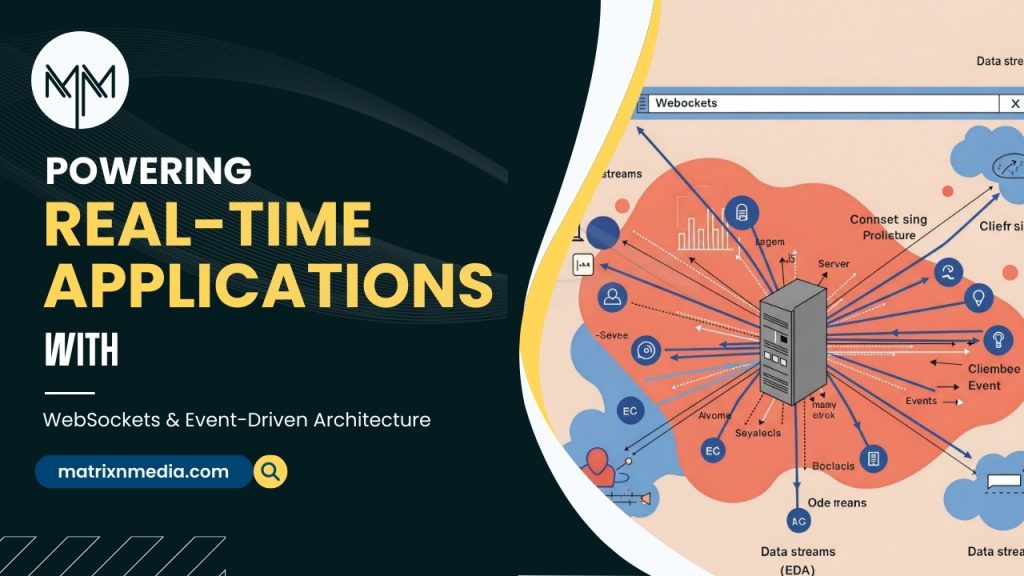
The success of modern applications depends on the ability of real-time communication. That’s because from live chat systems and collaborative tools to real-time analytics and gaming platforms, users expect instantaneous interactions. To meet these demands, businesses need a notable architecture that supports real-time interactions at scale.
Our experienced developers at Matrix Media Solutions leverage WebSockets and event-driven architecture to build scalable, high-performance applications that redefine real-time user experiences. Take this blog as a guide, in which we are going to explain how we work with WebSockets and event-driven architecture (EDA) together to power these applications, and why they are essential for businesses looking to stay competitive in a hyper-connected world.
The Growth of Real-Time Applications
The demand for real-time applications has skyrocketed in recent years. Whether it’s a live sports update, a stock market ticker, or a multiplayer gaming session, users no longer tolerate delays. Traditional request-response models, where clients repeatedly poll servers for updates, are inefficient and fail to meet these expectations. This is where WebSockets and event-driven architecture come into play.
WebSockets provide a full-duplex communication channel over a single, long-lived connection, enabling real-time data exchange between clients and servers. Event-driven architecture, on the other hand, allows systems to react to events as they occur, making it ideal for handling real-time data streams. Together, these technologies form the foundation of scalable, high-performance real-time applications.
What Makes WebSockets Important?
The development of real-time apps has been completely transformed by WebSockets. WebSockets preserve a persistent connection between the client and server, in contrast to HTTP, which is stateless and necessitates a fresh connection for every request. This enables fast data flow and removes the overhead of continually establishing connections.
WebSockets have been used by Matrix Media Solutions since a long time to develop applications that need low-latency communication. WebSockets, for instance, allow for real-time discussion, audience responses, and synchronised playing across several devices in a live video streaming platform. In a similar vein, WebSockets guarantee that modifications made by one user in a collaborative document editing tool are immediately reflected for all other users.
The benefits of WebSockets include:
- Low Latency: By maintaining a persistent connection, WebSockets reduce the delay typically associated with HTTP polling.
- Efficiency: WebSockets minimize bandwidth usage by eliminating the need for repeated connection setups and teardowns.
- Scalability: With proper architecture, WebSockets can handle thousands of concurrent connections, making them ideal for large-scale applications.
The Power of Event-Driven Architecture
Event-driven design guarantees that systems can process and react to events in real time, while WebSockets supply the communication layer. Instead of following a preset flow of actions, components in an event-driven system respond to events (such as a user sending a message or a sensor detecting motion).
Event-driven architecture is what we have used to create scalable and incredibly responsive systems. For example, with a real-time analytics dashboard, updates are displayed quickly in response to events like user interactions or system data. Faster decision-making is made possible by this strategy, which guarantees that stakeholders have access to the most recent information.
Key advantages of event-driven architecture include:
- Decoupling: Components in an event-driven system are loosely coupled, making it easier to scale and maintain the application.
- Flexibility: New features can be added by simply introducing new event handlers without disrupting existing functionality.
- Resilience: Event-driven systems are inherently fault-tolerant, as failures in one component don’t necessarily affect others.
Combining WebSockets and Event-Driven Architecture
The true power of real-time applications lies in the synergy between WebSockets and event-driven architecture. WebSockets provide the communication channel, while event-driven architecture ensures that the system can process and react to events efficiently.
We’ve successfully combined these technologies to build scalable, real-time applications. Here’s how we do it:
- Event Producers: These are the sources of events, such as user actions, IoT devices, or external APIs. For example, in a live auction platform, a bid placed by a user is an event.
- Event Bus: Events are sent to the proper handlers via the event bus, which serves as a central hub. It guarantees that events are presented accurately and in the right sequence.
- WebSocket Server: The WebSocket server maintains connections with clients and broadcasts events in real time. It acts as the bridge between the event bus and the clients.
- Event Handlers: These are the components that process events and perform actions, such as updating a database or triggering a notification.
By integrating these components, we create a system that can handle high volumes of real-time data while remaining scalable and resilient.
Challenges and Best Practices
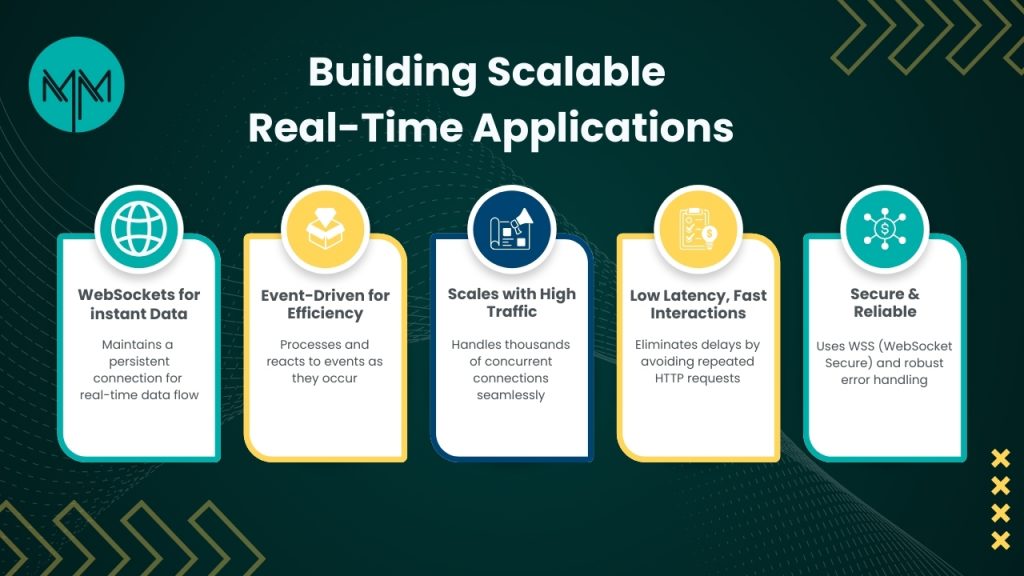
Building scalable real-time applications is not without its challenges. We’ve encountered and overcome several hurdles, and we’d like to share some best practices:
- Connection Management: Managing thousands of WebSocket connections can strain server resources. Use connection pooling and load balancing to distribute the load evenly across servers.
- Message Serialization: Optimize the size of messages sent over WebSockets to reduce latency. Make use of effective serialisation formats such as MessagePack or Protocol Buffers.
- Error Handling: Implement robust error handling to ensure that connections are re-established in case of failures. Use heartbeat mechanisms to detect and close stale connections.
- Security: Secure WebSocket connections using WSS (WebSocket Secure) and validate incoming messages to prevent injection attacks.
- Monitoring and Logging: Monitor WebSocket connections and event flows to identify bottlenecks and troubleshoot issues. Use tools like Prometheus and Grafana for real-time monitoring.
Real-World Applications
We’ve applied these principles to build a variety of real-time applications across industries. Here are a few examples:
- Live Streaming Platforms: We’ve developed platforms that support real-time chat, audience engagement, and synchronized playback for live events.
- Collaborative Tools: Our collaborative document editing tools enable multiple users to work on the same document simultaneously, with changes reflected in real time.
- IoT Dashboards: We’ve built dashboards that visualize real-time data from IoT devices, enabling businesses to monitor and control their operations remotely.
The Future of Real-Time Applications
Real-time applications will become more and more necessary as technology develops. The capabilities of real-time systems will be further improved by emerging developments like edge computing, 5G, and AI-driven analytics. Matrix Media Solutions is thrilled to be leading this change by assisting companies in utilising WebSockets and event-driven architecture to create the applications of the future.
Conclusion
Real-time apps are now essential rather than optional. Businesses can provide the responsive, real-time experiences that consumers expect by utilising WebSockets and event-driven architecture. We have direct experience with how these technologies can spur innovation and change entire sectors. The scalability, efficiency, and flexibility required to thrive in today’s digital world are provided by the combination of WebSockets and event-driven architecture, whether you’re creating an IoT dashboard, a live streaming platform, or a collaborative tool.
We can assist you if you’re prepared to advance your real-time application. Contact us without hesitation in order to build the perfect platform that you need to grow your business!
 August 30, 2024