




At present, businesses are gradually transitioning from monolithic architectures to microservices, primarily to enhance agility, expandability, and fault isolation. Microservices enable faster development cycles, independent deployments, and easier maintenance. According to reports, most firms, including 75% to 84% of medium-sized businesses and 85% of large enterprises, have already switched to microservices designs.
One of the most critical decisions businesses are facing is how to manage vast data. That’s because effective data management in microservices directly impacts scalability, performance, and operational efficiency.
Matrix Media Solutions, a leading mobile app and web development company, helps organizations manage these complexities by offering insights into two common approaches: Database Per Service, and Shared Database.
Several variables, such as the necessity for scalability, service independence, and data consistency, influence the best course of action. This blog will cover both strategies, as well as their advantages, difficulties, and ideal applications.
Explaining Database Per Service
Feature: In the Database Per Service model, each microservice has its dedicated database. This approach ensures strong service autonomy and data encapsulation, allowing services to evolve independently.
Benefits:
- Service Independence: Each microservice can be developed, deployed, and scaled without dependencies on other services.
- Improved Performance: Since services interact with their databases, queries, and transactions are faster and more efficient.
- Technology Flexibility: Different microservices can use different database technologies based on specific requirements (e.g., SQL for transactions, NoSQL for high-speed data access).
- Better Fault Isolation: Issues in one database do not directly impact other services, improving overall system resilience.
Challenges:
- Data Consistency: Ensuring consistency across multiple services can be complex and may require distributed transactions or event-driven approaches.
- Complex Data Management: Maintaining separate databases increases administrative overhead.
- Cross-Service Queries: Aggregating data across multiple microservices can be challenging and may require an additional data layer or API orchestration.
Best Use Cases For Database Per Service
The “Database Per Service” architectural pattern finds its best use cases in large-scale applications characterized by diverse data requirements. It proves particularly valuable in systems where high service autonomy and independent scalability are crucial, allowing each service to manage its data store without interference.
Moreover, this pattern is highly suitable for applications employing polyglot persistence, enabling the selection of the most appropriate database technology for each service’s specific needs, thus optimizing performance and efficiency.
Shared Database Comparison
Features: In this model, all microservices access a common database, often using different schemas or tables to maintain some level of separation. This model is closer to the traditional monolithic architecture but with microservices accessing data independently.
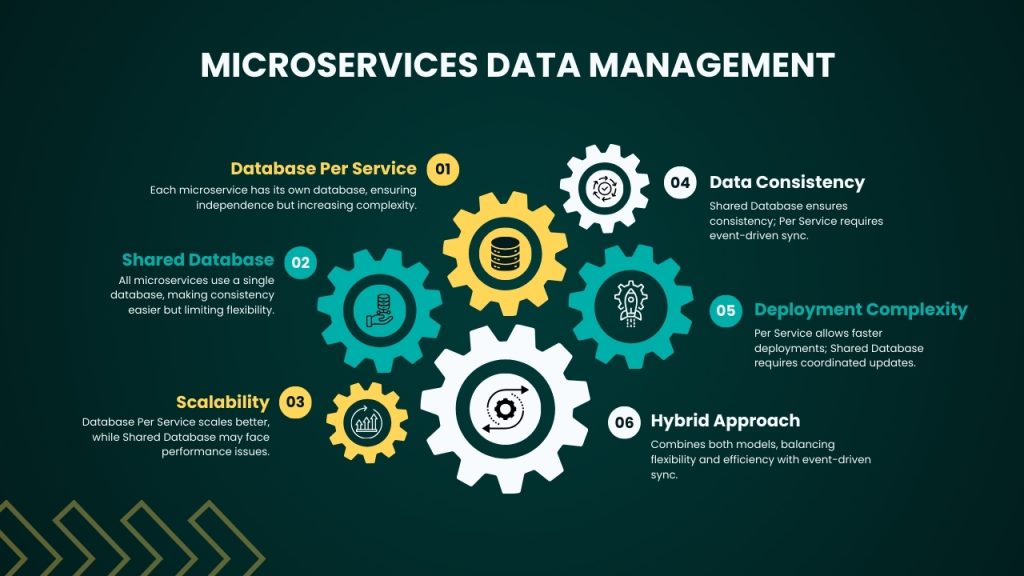
Benefits:
- Simplified Data Consistency: Since all services use the same database, maintaining consistency across transactions is easier.
- Simplified Reporting & Analytics: Querying across multiple services is straightforward since all data resides in a single repository.
- Reduced Infrastructure Complexity: Managing a single database is often easier than handling multiple distributed databases.
Challenges:
- Limited Service Independence: Changes to the database schema may impact multiple services, reducing flexibility.
- Performance Bottlenecks: High traffic from multiple services can strain a single database, affecting scalability.
- Deployment Complexity: Coordinating database changes across services can introduce dependencies, slowing down development cycles.

Best Use Cases for Shared Database
Strong consistency is paramount in applications like financial systems, where data integrity is non-negotiable. Additionally, systems with limited scalability needs often benefit from the simplicity and control offered by centralized data management.
Furthermore, organizations undergoing a transition from monolithic architectures to microservices might find strong consistency useful as a stepping stone, providing a degree of familiarity and control before fully embracing the complexities of database decoupling.
Key Considerations for Choosing the Right Approach
When it comes to selecting a specific architecture for your business, it gets overwhelming. Choosing the right approach depends on various factors, therefore we evaluate every details before recommending a database strategy for microservice applications:
- Data Consistency vs. Service Independence
- If strong consistency is a priority → Shared Database.
- If microservices should operate independently → Database Per Service.
- Scalability and Performance
- If high scalability and performance are required → Database Per Service.
- If managing a single database is preferred for simpler applications → Shared Database.
- Cross-Service Data Access
- If multiple services frequently need to query the same dataset → Shared Database.
- If services can work with their own datasets and share data asynchronously → Database Per Service.
- Deployment Complexity
- If faster deployments with fewer dependencies are needed → Database Per Service.
- If centralized control over data schema is important → Shared Database.
The Hybrid Approach: Best of Both Worlds
Many modern architectures leverage a hybrid approach, where services primarily use independent databases but also interact with a shared read-only data store or event-driven data synchronization mechanisms.
Example of Hybrid Strategies
CQRS (Command Query Responsibility Segregation): Write operations go to individual service databases, while reads use a shared data store.
Event Sourcing: Services publish events to a shared event bus, allowing other services to sync relevant data without direct database dependencies.
Materialized Views: Data is periodically aggregated into a separate database for reporting and analytics.
This approach allows teams to balance service independence with data accessibility, optimizing performance and consistency.
Conclusion
Choosing between Database Per Service and Shared Database is a strategic decision, that is going to impact impacts the long-term scalability and efficiency of microservices applications of your business.
Our specialty at Matrix Media Solutions is creating customized data architectures for microservices, which enable companies to grow effectively while upholding sound data management procedures. We offer professional advice to assist you in making the best decision, regardless of whether you require fully autonomous services with dedicated databases or a more straightforward, shared data architecture.
If you’re looking to optimize your microservices data strategy, reach out to us without any further delay. We will help you to build scalable, high-performance applications customized to your unique business needs!