

Matrix Media Solutions has worked with businesses of all sizes, from startups to enterprises, to develop scalable, secure, and future-ready applications. In this guide, we’ll walk you through both architectures, their pros and cons, and how to decide what suits your business goals.
Understanding the Two Models
What is a Monolithic Architecture?
A monolithic architecture is a conventional software design in which the application’s user interface, business logic, and database access are all constructed from a single, cohesive codebase. The application operates as a single process upon deployment.
Typical features:
- Unified codebase
- Centralized database
- Tightly coupled components
We often recommend monoliths for smaller projects or MVPs that need fast development and don’t anticipate complex scaling requirements initially.
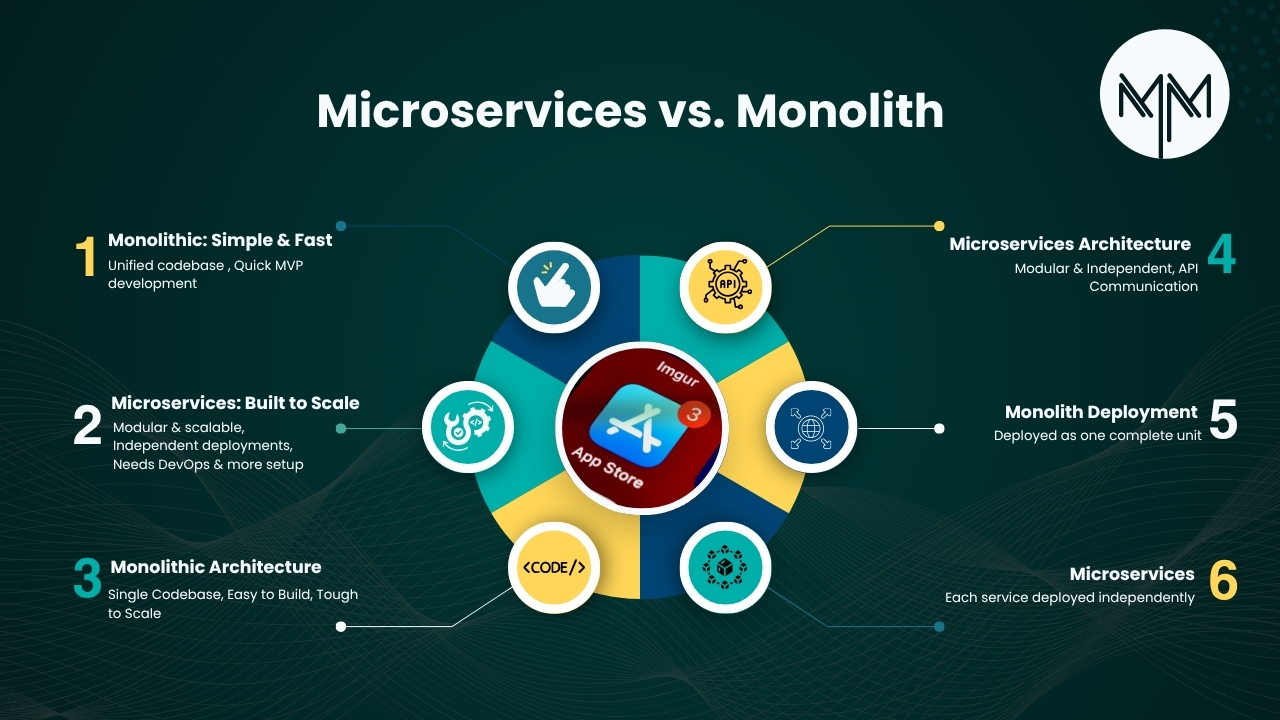
Pros and Cons of Each Architecture
Let’s break it down:
Advantages of Monolithic Architecture
1. Simpler to develop and deploy:
A monolith is ideal when you’re just starting one codebase, as it means less initial complexity.
2. Better performance for small apps:
For simple applications with minimal user load, monoliths often run faster without the overhead of inter-service communication.
3. Easy debugging and testing:
Everything is in one place, so testing and troubleshooting are more straightforward.
Disadvantages of Monolithic Architecture
1.Scalability limitations:
Scaling requires the whole application to be replicated, even if only one component is under heavy load.
2.Deployment risks:
A small change in one module can potentially affect the whole application.
3.Slower development over time:
As the codebase grows, it becomes harder to manage and understand.
Advantages of Microservices Architecture
1. Scalability and flexibility:
Services can be scaled independently, optimizing resource usage and cost.
2. Faster development cycles:
Bottlenecks can be reduced by teams working on many services at once.
3. Technology diversity:
Teams can use different programming languages and tools per service, enabling innovation and faster adoption of new technologies.
4. Fault isolation:
A failure in one service doesn’t bring down the whole application.
Disadvantages of Microservices Architecture
1.Increased complexity:
Managing many services, API communications, and deployments requires robust DevOps practices.
2.Higher operational overhead:
More services mean more monitoring, logging, and testing efforts.
3.Network latency:
Since services communicate over the network, performance can be impacted if not optimized.
What We Recommend
We don’t believe in a one-size-fits-all model. Here’s how we typically guide our clients:
1.For Startups-
Monolithic: You need to get your product to market fast. A monolithic approach allows quick iteration and easy deployment without the overhead of distributed systems.
2.For an Ecommerce business-
Microservices: Individual services like payment, inventory, and user authentication can be scaled based on demand, saving infrastructure costs and improving performance during high-traffic periods.
3.For Mid-Sized SaaS Platform-
Hybrid (start with monolith, move to microservices): Begin with a monolith to establish core functionalities. As your user base grows and services become more complex, slowly transition to a microservices architecture.
4.DevOps and CI/CD: Critical Enablers
For microservices to succeed, automation is key. We implement CI/CD pipelines that enable frequent, reliable updates and zero-downtime deployments. Tools like Jenkins, Docker, Kubernetes, and GitHub Actions are part of our go-to tech stack to support this transition.
With monolithic applications, CI/CD also plays a role in maintaining release consistency, though the process is simpler due to the unified codebase.
Security Considerations
Security differs vastly between the two architectures:
- Monolithic: Centralized security controls make it easier to monitor, but pose a single point of failure.
- Microservices: Require security at multiple levels—API gateway, service-to-service authentication, data encryption, but offer compartmentalization of vulnerabilities.
- Matrix Media ensures secured DevSecOps integration into both models, automating security checks in the development pipeline, regardless of your chosen architecture.
Cost Implications
- A critical factor is the total cost of ownership (TCO).
- Monoliths are cheaper to build and maintain initially, making them ideal for early-stage startups and proof-of-concept projects.
- Microservices require a larger initial investment but pay off in the long run through better scalability, faster deployments, and efficient team collaboration.
- Our job at Matrix Media is to help clients balance immediate needs with future scalability, ensuring a smooth architectural transition when the time is right.

Final Thoughts: Making the Right Choice
Selecting the best application architecture is a commercial strategy as much as a technological one. At Matrix Media Solutions, we align our recommendations with your business objectives, development capacity, and long-term vision.
Our advice:
- Start monolithic if your app is simple and needs quick market entry.
- Opt for microservices when you expect rapid growth, high availability, and complex functionalities.
- Choose a hybrid path for projects that will evolve significantly over time.
Need Guidance? Let’s Talk.
Matrix Media Solutions offers consulting, development, and support to help businesses implement the right architecture. Our staff is here to help you succeed, whether you’re launching a new app or revamping an old one.
Contact us today to explore the best architecture for your project!