



The Micro-Frontend Architecture Debate: Insights from Matrix Media Solutions
The micro-frontend architecture has emerged as one of the most debated topics in modern web development. Over the past few years, Matrix Media Solutions, a leading website development company, has implemented micro-frontend architectures for enterprises. One of the main lessons from this implementation is that the decision to split isn’t always straightforward.
Today, we’re sharing our insights on when micro-frontends make sense and when they might be overkill.
Understanding Micro-Frontends
By extending the idea of microservices to the frontend, micro-frontends enable teams to independently create, implement, and manage various web application components. Imagine it as disassembling a large frontend into smaller, more manageable components that various teams can take ownership of.
Micro-frontends, in contrast to backend microservices, have particular difficulties. You’re juggling the intricacy of coordinating several apps in a single browser session, shared state, consistent user experience, and performance consequences.
When Micro-Frontends Make Perfect Sense
Large, Multi-Team Organizations
The most successful micro-frontend implementation generally happens for financial services clients. Each team owned a specific business domain – accounts, transactions, reporting, and compliance. The micro-frontend approach allowed each team to choose their preferred tech stack and deploy independently without blocking other teams.
The key indicators:
- More than 6–8 developers need to work on the frontend
- Clear business domain boundaries
- Teams with different technical preferences or expertise levels
- Frequent deployment cycles that would otherwise create bottlenecks
Legacy System Integration
We have previously helped a retail client modernize their legacy system by gradually replacing components with micro-frontends. Instead of a risky big-bang rewrite, they could incrementally migrate features while maintaining the existing system.
This approach works particularly well when:
- You have a stable legacy system that needs gradual modernization
- Different parts of the application have varying modernization priorities
- You want to reduce technical risk during major upgrades
Diverse User Experiences
One of our e-commerce clients needed dramatically different experiences for B2B and B2C users. The checkout process, product catalogs, and user dashboards were completely different. Micro-frontends allowed specialized teams to optimize each experience independently.
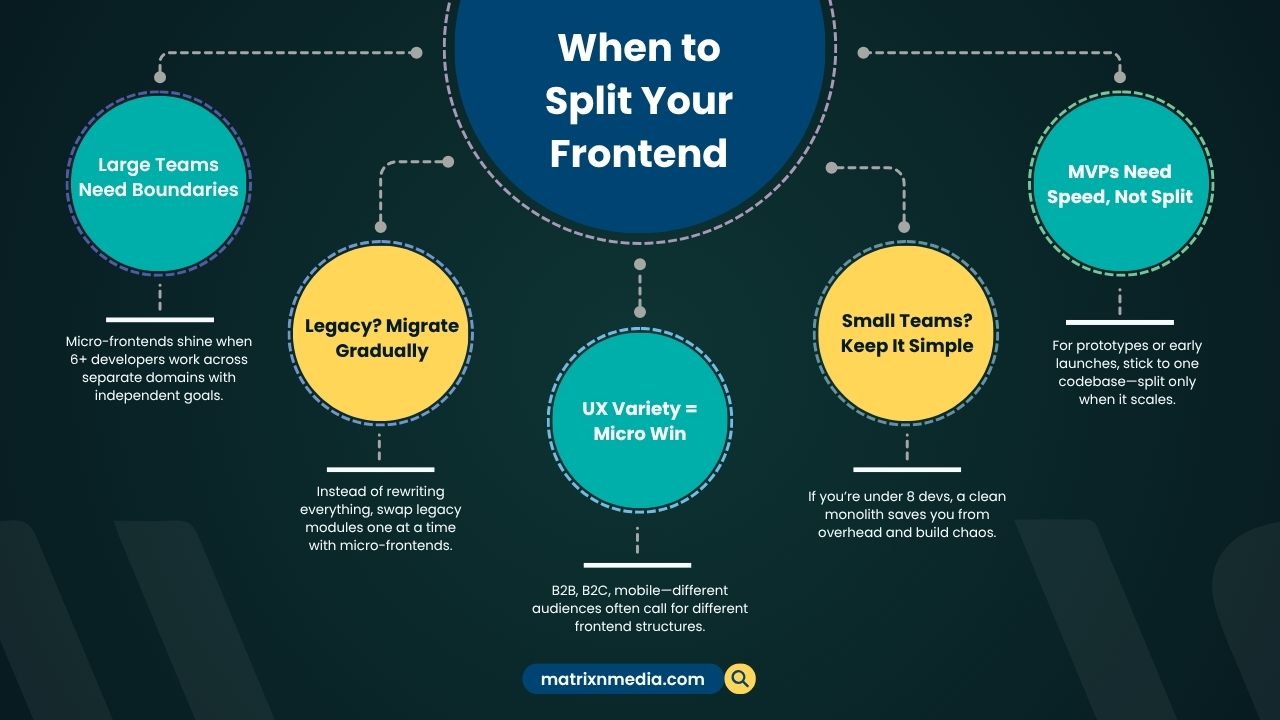
When to Keep It Simple: The Monolith Advantage
Small to Medium Teams
For teams with fewer than 8 developers, micro-frontends often create more problems than they solve. We’ve seen startups adopt micro-frontends prematurely, leading to:
- Increased complexity without corresponding benefits
- Overhead in managing multiple build pipelines
- Difficulty in sharing code and maintaining consistency
Highly Integrated User Experiences
Social media platforms, collaborative tools, and real-time applications often require tight integration between components. One client initially wanted to split their project management tool into micro-frontends, but we recommended against it due to the extensive shared state and real-time collaboration features.
Rapid Prototyping and MVPs
When speed to market is critical, monolithic frontends allow for faster iteration and easier refactoring. We always recommend starting simple and splitting later when the business case becomes clear.
The Technical Reality: What We’ve Learned
Performance Isn’t Automatic
- Contrary to popular belief, micro-frontends don’t automatically improve performance. They can harm it if not implemented carefully. We’ve seen:
- Increased bundle sizes due to duplicate dependencies
- Initial load times caused by numerous network requests are slower
- Complex caching strategies are required to optimize performance
Our solution: Implement module federation with careful dependency management and aggressive caching strategies.
Shared State Complexity
Managing state across micro-frontends is challenging. It can be experimented with various approaches:
- Event-driven communication – Works well for loosely coupled components
- Shared state libraries – Effective, but requires careful coordination
- URL-based state – Simple but limited in scope
Testing Becomes Complicated
Integration testing across micro-frontends requires sophisticated tooling. It needs to be invested heavily in containerized testing environments and cross-application test suites.
Our Decision Framework
It’s better to use this framework to evaluate micro-frontend adoption:
Team Structure Assessment
- Do you have multiple autonomous teams?
- Are there clear ownership boundaries?
- Can teams commit to maintaining independent deployment pipelines?
Technical Complexity Analysis
- How much shared state exists between components?
- Are there performance requirements that could be impacted?
- Do you own the necessary infrastructure to accommodate several applications?
Business Requirements Evaluation
- Are there different user personas with distinct needs?
- Do different parts of the application have varying change frequencies?
- Is there a need for technology diversity?

Implementation Strategies That Work
Start with Domain-Driven Design
Before splitting technically, split conceptually. Map your business domains and identify natural boundaries. This upfront work prevents awkward splits later.
Invest in Tooling
Successful micro-frontend implementations require excellent tooling:
- Unified build and deployment pipelines
- Shared component libraries
- Cross-application testing frameworks
- Monitoring and observability tools
Gradual Migration
We always recommend starting with a pilot micro-frontend to validate the approach. Choose a self-contained feature with minimal dependencies for your first split.
Conclusion
Although they constitute a strong architectural pattern, micro-frontends are not a panacea. Organizational requirements, not personal preferences for technology, should guide the choice. We at Matrix Media Solutions have witnessed both highs and lows during website development, and the key to success is always selecting the appropriate instrument for the given situation.
Assessing your team structure, business needs, and technical limitations honestly is the first step if you’re thinking about micro-frontends. Keep in mind that the greatest design is the one that allows your team to constantly create value while also successfully serving your users.
When the organizational advantages of micro-frontends exceed the technical expenses, their complexity can be justified. However, embrace the simplicity of a well-structured monolith if you’re a small team developing a closely linked application. Contact us!
 June 21, 2024