

We are in the era of a data-saturated digital economy, where the most critical success factors are agility, scalability, and responsiveness. People are more worried about AI automation, whether it will help them or replace them. In this moment, event-driven architecture (EDA) has emerged as a powerful model that aligns perfectly with the demands of AI automation, allowing systems to react to real-time changes and automate decision-making intelligently.
At Matrix Media Solutions, we’ve integrated EDA into various AI-powered platforms to create smarter, more resilient, and more dynamic solutions for our clients across industries. This blog explores the key patterns of event-driven architecture, common pitfalls in implementation, and proven best practices to successfully integrate EDA in AI automation workflows.
Understanding Event-Driven Architecture in AI Automation
A software design pattern known as “Event-Driven Architecture” uses the creation, detection, and response to events to facilitate communication between services and initiate activities. Anything can be considered a “event”: a system anomaly, a sensor update, a human activity, or a change in data.
These events are used as inputs to logic engines or machine learning models in AI automation, which decide the subsequent automated actions, such as identifying abnormalities, streamlining processes, or issuing proactive alerts.
The Reasons AI and EDA Are a Perfect Fit
-
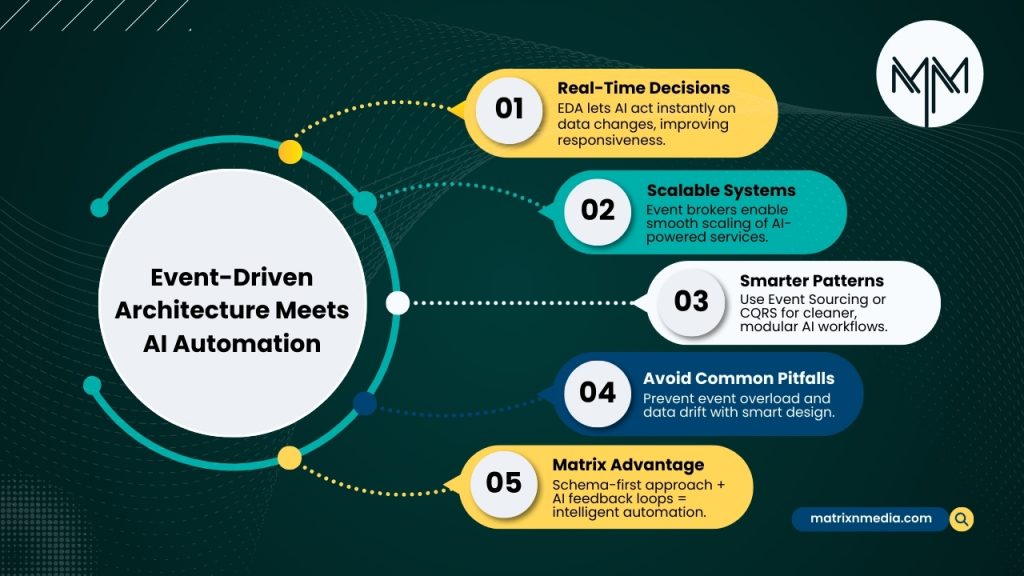
Real-Time Processing: AI algorithms thrive on real-time data. EDA ensures systems ingest and process data as it happens.
-
Decoupled Systems: Event producers don’t need to know the consumers, allowing AI components to be swapped or scaled independently.
-
Scalability: Event brokers and stream processing tools enable horizontal scaling, vital for AI tasks like image processing, NLP, and predictive analytics.
- Responsiveness: Combined with AI, EDA enables intelligent reactions, not just automated ones.
Common Architectural Patterns in EDA for AI
Our experts follow these event-driven patterns when architecting AI automation systems:
-
Event Notification Pattern:
This is the simplest form of EDA, where a component generates an event and others listen. For example, a sensor might emit a temperature threshold event, which then triggers an AI model to determine whether machinery maintenance is required.
-
Event-Carried State Transfer:
The event carries data with it, allowing the consumer to make decisions without querying the producer. This pattern reduces latency and supports autonomous AI decisions.
-
Event Sourcing:
Every modification made to an application’s state is recorded as a series of actions. These can then be played back to train AI models or rebuild the state.
-
CQRS (Command Query Responsibility Segregation):
Used with EDA to separate read and write responsibilities — enabling efficient, scalable AI-driven analytics while keeping business logic clean and consistent.
The Pitfalls: Challenges When Integrating EDA with AI
While the benefits of EDA in AI automation are immense, implementation requires careful planning to avoid common pitfalls:
-
Event Storming:
Poorly defined event granularity can overwhelm systems with too many events, leading to excessive processing and degraded performance. This affects AI pipelines, which rely on clean, meaningful input signals.
Matrix Tip: Design events with domain context and avoid emitting redundant updates. -
Eventual Consistency Issues:
EDA introduces eventual consistency, which AI algorithms might not tolerate well, especially those that rely on precise sequencing or time-sensitive data.
Matrix Tip: Introduce timestamped events and distributed consensus mechanisms for sensitive workflows. -
Debugging and Observability:
Distributed, decoupled services can make it difficult to trace issues. When AI doesn’t behave as expected, root cause analysis across multiple services becomes complex.
Matrix Tip: Use centralized event tracing tools and attach metadata (like correlation IDs) for AI interpretability. -
Data Integrity Risks:
AI models are susceptible to inconsistent and drifting data. Schema stability and cross-service data validation are essential in an EDA configuration.
Matrix Tip: Apply schema validation tools like Protobuf or Avro and set up drift monitoring pipelines.

Best Practices for Success in EDA-Driven AI Automation
We’ve learned from hands-on projects in logistics, fintech, and healthcare. Here are our proven strategies:
-
Use the Right Event Broker:
Choose significant brokers like Apache Kafka, RabbitMQ, or AWS EventBridge based on your volume, latency, and scaling needs. Kafka is great for high-throughput AI pipelines; EventBridge simplifies event routing in AWS-native environments.
-
Standardize Event Contracts:
Clearly define event schemas using tools like JSON Schema or Avro. This avoids misunderstandings between services and ensures that AI models receive structured, expected inputs.
-
Implement AI Feedback Loops:
Allow AI predictions or decisions to feed back into the event stream, enabling smooth learning and performance tuning.
-
Treat AI Models as Services:
Deploy models via APIs or microservices so they can subscribe to or respond to events easily. Use model serving platforms like TensorFlow Serving, MLflow, or AWS SageMaker.
-
Monitor, Log, Retrain:
Monitoring AI in production isn’t optional. Use AIOps tools to watch model behavior, trigger retraining events, and flag anomalies.
Conclusion: A fundamental concept for increasing the scalability, responsiveness, and intelligence of AI automation, event-driven architecture is more than simply a catchphrase. When implemented properly, it allows companies to create self-optimizing, real-time systems that think rather than just react.
Our specialty at Matrix Media Solutions is assisting businesses in transitioning from rigid, rule-based automation to flexible, AI-driven event ecosystems. We guarantee that your automation plan is future-proof, from selecting the appropriate tools and creating scalable patterns to controlling model drift and feedback loops.
We would be delighted to assist you in creating the plan if you are investigating how EDA and AI can transform your company’s operations.