



Scaling Frontend in 2025: Micro Frontends Frameworks and Strategies from Matrix Media
The digital products are growing large and more complex; in the meantime, maintaining a scalable front-end architecture becomes increasingly challenging. Traditional monolithic front-end applications can become unwieldy, slow down development, and hinder collaboration across teams.
Herein lies the role of Micro Frontends, an architectural technique that is rapidly gaining popularity in 2025 for efficiently scaling user interfaces.
Our experience at Matrix Media Solutions shows us how using Micro Frontends enables businesses to create scalable, modular, and maintainable user interface ecosystems. This blog will discuss the definition of micro frontends, their significance in 2025, and the newest frameworks and tactics for their effective implementation.
Defining Micro Frontends
The Microservices concept is carried across to the front end with Micro Frontends. The user interface is divided into smaller, independent parts, or “frontends,” each of which is created, tested, and implemented separately, rather than being a single, sizable frontend codebase. Together, these micro-applications create a seamless user experience.
Essentially, Micro Frontends enhance agility, decrease dependencies, and facilitate continuous delivery at scale by enabling many teams to work independently on various UI components.
The Significance of Micro Frontends in 2025
The front-end scenario in 2025 has changed significantly:
- Complex User Interfaces: Modern web apps require diverse features and integrations.
- Distributed Teams: Many organizations now have globally distributed development teams.
- Faster Time-to-Market: Businesses demand rapid feature releases without compromising quality.
- Multiple Frameworks Coexist: Legacy apps and new features often rely on different front-end frameworks.
Micro Frontends address these challenges by enabling:
- Independent Deployments: Teams deploy updates to their micro frontends without waiting for a full app release.
- Technology Diversity: Various frameworks can be used to create various micro frontends. (React, Vue, Angular, or others).
- Scalable Collaboration: Certain features or modules may be owned by several teams.
- Improved Maintainability: Smaller codebases are easier to understand and update.
Frameworks Powering Micro Frontends in 2025
Module Federation (Webpack 5+)
Module Federation, introduced by Webpack 5, is a game-changer for Micro Frontends. It allows JavaScript applications to dynamically load code from another application at runtime, meaning micro frontends can share dependencies and update independently without page reloads.
Why it stands out:
- Shared libraries reduce duplication and bundle sizes.
- Smooth integration with existing Webpack setups.
- Strong community and ecosystem support.
Single-SPA
A well-liked JavaScript framework called Single-SPA was created especially for coordinating several micro frontends on a single page. It makes it possible for apps created using several frameworks to function together seamlessly.
Key benefits:
- Supports React, Angular, Vue, and more in one app.
- Enables lazy loading of micro frontends for performance optimization.
- Handles routing across micro-apps seamlessly.
Bit
Bit is a platform that enables component-driven development by allowing teams to build, share, and manage UI components independently. It complements Micro Frontends by promoting reusable and versioned components across projects.
Advantages:
- Provides component versioning and governance.
- Simplifies component sharing across micro frontends.
- Enhances collaboration and code consistency.
Qiankun
Qiankun is a micro frontend framework inspired by Single-SPA, but with additional features like lifecycle hooks and sandboxing that improve isolation between micro apps.
Qiankun’s efficacy:
- Simple integration with minimal boilerplate.
- Better isolation prevents style and script conflicts.
- Strong in enterprise scenarios requiring complex micro frontend setups.
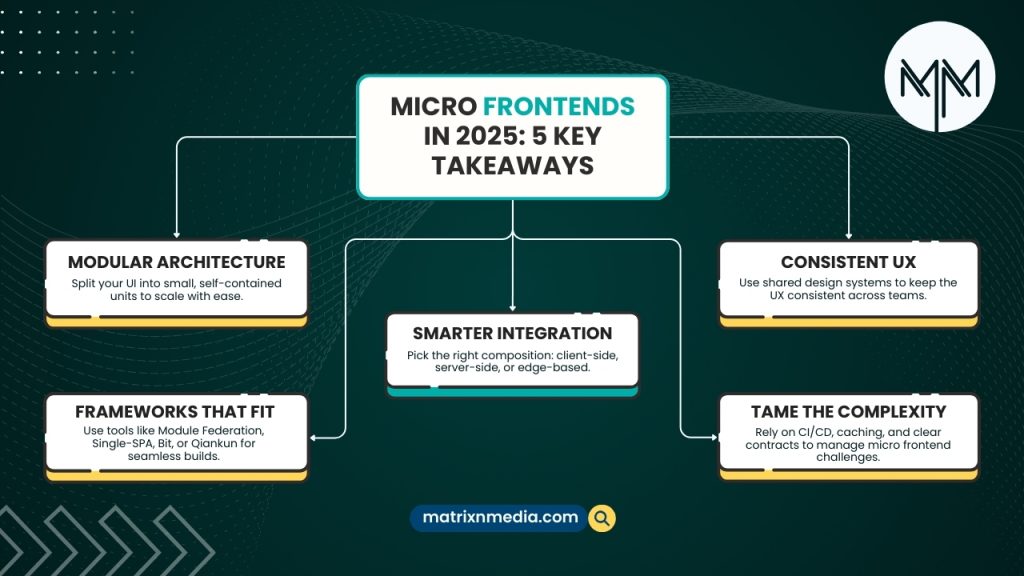
Strategies for Scaling Your UI with Micro Frontends
Implementing Micro Frontends requires thoughtful planning to reap their full benefits. Here are some key strategies our team at Matrix Media Solutions follows:
Define Clear Ownership Boundaries
Before diving into code, define boundaries around features, domains, or vertical slices of your UI that can be developed independently. This reduces overlap and minimizes cross-team dependencies.
For example, one micro frontend might handle user authentication, another manages the dashboard, and yet another handles notifications.
Choose the Right Integration Approach
Common integration patterns include:
- Client-side Composition: Micro frontends load in the browser and combine to form the page. Great for dynamic UIs but requires handling loading states and communication carefully.
- Server-side Composition: Server assembles micro frontends into a single response, improving performance but increasing backend complexity.
- Edge-side Composition: CDN or edge servers stitch micro frontends, offering a balance between server and client composition.
Choosing the right method depends on performance needs, infrastructure, and complexity.
Standardize Communication Between Micro Frontends
Due to their autonomy, micro frontends need a robust communication infrastructure. Among the choices are:
- Custom Events: Lightweight and simple for basic interactions.
- Shared State Libraries: Like Redux or RxJS for complex data sharing.
- Global Event Bus or Pub/Sub Systems: Decouple micro frontends further.
At Matrix Media Solutions, we emphasize designing communication to avoid tight coupling.
Ensure Consistent User Experience
Different micro frontends may use different frameworks or styles, so UX consistency is paramount. Establish shared design systems, UI component libraries, and theming guidelines that micro frontend teams must follow.
Implement Efficient CI/CD Pipelines
Micro Frontends shine with independent deployment. Set up CI/CD pipelines that allow each team to build, test, and deploy their micro frontend independently while ensuring integration testing catches issues early.
Challenges and How to Overcome Them
Although micro frontends have many advantages, they also present new difficulties.
- Increased Complexity: Managing multiple repos, deployments, and versions can get complicated.
- Solution: Invest in automation and tooling to streamline workflows.
- Performance Overhead: If not optimised, several micro frontends may result in longer load times.
- Solution: Make use of shared dependencies, effective caching, and lazy loading.
- Cross-Team Coordination: Despite independence, teams still need to sync on APIs and UX.
- Solution: Clear interface contracts and consistent communication.
- SEO and Accessibility: Ensure micro frontends do not compromise SEO or accessibility standards.
Our experts at Matrix Media Solutions help clients navigate these challenges through tailored architectural consulting and proven best practices.

Conclusion
In 2025 and beyond, micro frontends will be the standard for scalable front-end development. Organisations can create more resilient apps, empower teams, and speed up development cycles by disassembling monolithic user interfaces into smaller, independent components.
At Matrix Media Solutions, we help companies successfully use Micro Frontends by fusing our extensive technical knowledge with a team-oriented strategy. We customise solutions to meet your specific needs, whether you’re updating outdated apps or creating brand-new products from the ground up.
Ready to scale your UI with Micro Frontends? Get in touch with us today to explore how our experts can help you architect the future of your front-end ecosystem.
 January 23, 2026