



At present, basic SEO tactics are no longer enough to secure top search engine rankings. While foundational elements like keyword optimization and meta descriptions remain important, search engines have evolved to prioritize user experience, content quality, and technical excellence.
As one of the leading digital marketing agencies, Matrix Media Solutions has helped countless businesses break through ranking plateaus by implementing advanced SEO strategies that deliver measurable results.
Technical SEO: Building a Strong Foundation
Core Web Vitals Optimization
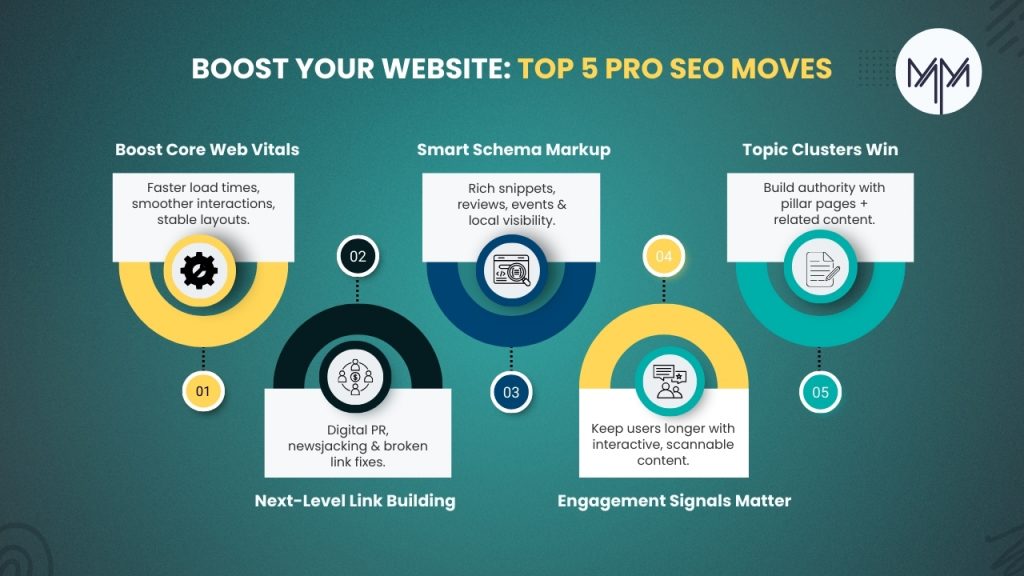
Google’s Core Web Vitals have become critical ranking factors, focusing on real user experience metrics. The three key metrics, Largest Contentful Paint (LCP), First Input Delay (FID), and Cumulative Layout Shift (CLS), directly impact how search engines evaluate your site’s performance. To optimize LCP, prioritize above-the-fold content loading by implementing lazy loading for images, optimizing server response times, and using content delivery networks (CDNs). For FID improvement, minimize JavaScript execution time and remove unused JavaScript. Reduce CLS by setting explicit dimensions for images and videos, avoiding dynamic content insertion above existing content, and using font-display: swap for web fonts.
Advanced Schema Markup Implementation
While basic schema markup helps search engines understand your content, advanced implementations can significantly enhance your search visibility. Implement the FAQ schema to capture featured snippets, use the Review schema to display star ratings in search results, and leverage the Event schema for time-sensitive content. E-commerce visibility can be increased with a product schema that includes comprehensive details about availability, pricing, and specifications. With improved information panels, the Local Business schema assists physical establishments in showing up in local search results.
Content Strategy Beyond Keywords
Semantic SEO and Topic Clustering
Modern search engines understand context and user intent better than ever. Instead of focusing solely on individual keywords, develop comprehensive topic clusters that demonstrate expertise across entire subject areas. Create pillar pages that cover broad topics comprehensively, then support them with cluster content addressing specific subtopics.This approach helps establish topical authority and captures long-tail search opportunities. Use tools to identify related terms and concepts that searchers associate with your main topics, then naturally incorporate these semantic keywords throughout your content.
Featured Snippet Optimization
Featured snippets appear in over 50% of search results, making them valuable real estate for visibility. To optimize for featured snippets, identify existing snippet opportunities in your niche by analyzing competitor content that currently holds these positions.Structure your content to directly answer common questions using clear, concise language. For process-based searches, use numbered lists; for feature comparisons, use bullet points; and for data-driven content, use tables. To aid search engines in understanding content structure, keep responses for paragraph snippets between 40 and 60 words, and make sure the heading hierarchy is correct.
Advanced Link Building Strategies
Digital PR and Newsjacking
Sophisticated digital PR tactics have replaced traditional link building. Creating timely, pertinent material that connects your business to news articles that are popular in your industry is known as “newsjacking.” High-quality backlinks from news websites and trade journals can be produced using this strategy.Develop relationships with journalists and industry influencers by providing expert commentary, conducting original research, and sharing unique insights. Create data-driven studies and surveys that naturally attract links from publications seeking credible sources.
Resource Page and Broken Link Building
Identify high-authority websites in your industry that maintain resource pages listing helpful tools, guides, or services. Reach out with genuinely valuable resources that would benefit their audience. This approach yields higher success rates than generic outreach because you’re offering clear value. Broken link building involves finding broken external links on relevant websites and suggesting your content as a replacement. Use tools to identify broken links on high-authority sites, then create content specifically designed to serve as an ideal replacement resource.
User Experience and Engagement Signals
Dwell Time and Bounce Rate Optimization
User engagement signals are being used more and more by search engines to assess the quality of content. One of the most important ranking factors is dwell time, or how long consumers stay on your page before going back to search results. By producing interesting, scannable information with distinct headings, bullet points, and graphic components, you may increase dwell time.Implement internal linking strategies that encourage users to explore additional pages on your site. Use related content suggestions, contextual links, and clear calls-to-action to guide users deeper into your website ecosystem.
Interactive Content and Multimedia Optimization
Interactive elements like calculators, quizzes, and interactive infographics increase engagement time and provide unique value that competitors can’t easily replicate. These elements also generate natural social shares and backlinks. Optimize multimedia content by using descriptive alt text for images, creating video transcripts for accessibility, and implementing structured data for video content. Consider creating video versions of popular blog posts to capture video search traffic and improve page engagement metrics.
Advanced Analytics and Performance Tracking
Beyond Traffic: Measuring SEO ROI
Move beyond vanity metrics like rankings and traffic to focus on conversion-oriented measurements. Track assisted conversions from organic search, monitor customer lifetime value from SEO traffic, and analyze the full customer journey from initial search to final conversion.Implement advanced Google Analytics configurations to track micro-conversions, set up custom conversion paths, and measure the impact of specific SEO initiatives on revenue generation.
Competitive Intelligence and Gap Analysis
Regular competitive analysis reveals opportunities and threats in your SEO landscape. Monitor competitor content strategies, identify keywords they’re ranking for that you’re not, and analyze their technical SEO implementations.Use competitive intelligence to inform your content calendar, identify emerging trends in your industry, and discover new link-building opportunities. This proactive approach helps you stay ahead of competitors rather than simply reacting to their strategies.
Future-Proofing Your SEO Strategy
As search engines continue evolving, successful SEO requires adaptability and forward-thinking approaches. Voice search optimization, artificial intelligence integration, and evolving user behaviors will shape the future of search engine optimization. At Matrix Media Solutions, we understand that advanced SEO is about creating sustainable, long-term value for both search engines and users. By implementing these sophisticated techniques while maintaining focus on user experience and content quality, businesses can achieve lasting search visibility and meaningful traffic growth. The key to advanced SEO success lies in viewing optimization as a comprehensive digital marketing strategy rather than isolated tactics. When technical excellence meets valuable content and strategic promotion, websites don’t just rank higher—they drive genuine business results that justify the investment in sophisticated SEO practices.