

Cart abandonment remains one of the most persistent challenges in e-commerce, with studies showing that nearly 70% of online shopping carts are abandoned before purchase completion.
For businesses investing heavily in attracting customers and filling those carts, this represents a massive opportunity cost. However, the silver lining is clear: most cart abandonment issues stem from preventable checkout friction that can be addressed through strategic optimization.
As a result, when it comes to the checkout flows of the ecommerce website development, the easy-to-manage features remain non-negotiable. Over the last few years, as a leading e-commerce development company, we have witnessed firsthand how thoughtful checkout design can transform conversion rates and drive substantial revenue growth for our clients.
Therefore, Matrix Media Solutions emphasizes that the key lies in understanding that checkout optimization is about removing every possible barrier between customer intent and purchase completion.
Understanding the Psychology Behind Cart Abandonment
It’s important to comprehend why customers abandon their carts before moving on to solutions. The most common culprits include unexpected costs, complicated checkout processes, security concerns, and a lack of preferred payment options. Additionally, forced account creation, slow loading times, and unclear return policies contribute significantly to checkout abandonment.
The modern consumer expects a seamless, intuitive experience that respects their time and privacy. When faced with unexpected friction, they’re more likely to abandon their purchase entirely rather than persist through a cumbersome process. This behavioral reality should inform every checkout optimization decision.
Simplifying the Checkout Process
Guest Checkout Options
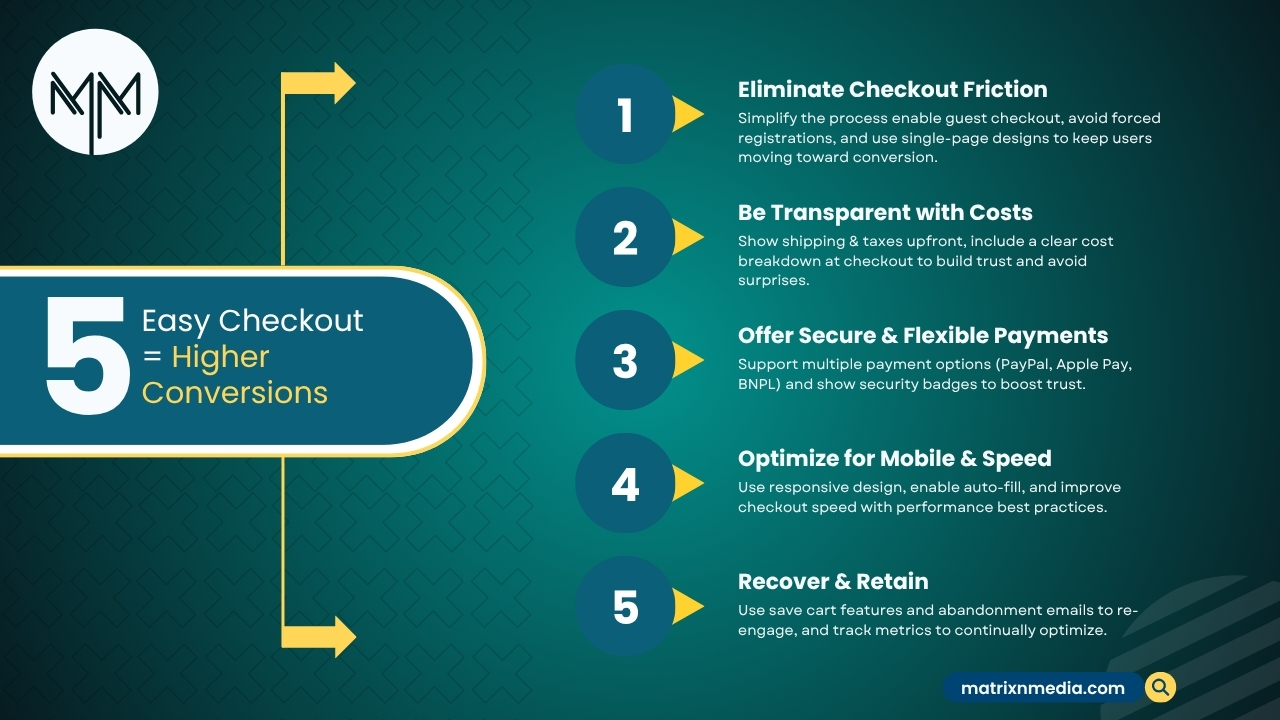
One of the most impactful changes any e-commerce site can make is offering guest checkout. Forcing customers to create an account before purchasing creates unnecessary friction and often triggers immediate abandonment. While account creation has long-term benefits for customer retention and marketing, it should never be mandatory for first-time purchases.
The most effective approach involves offering account creation as an optional step post-purchase, when customers are already satisfied with their experience and more likely to engage with your brand long-term.
Single-Page Checkout Design
Multi-page checkout processes create multiple opportunities for abandonment. Each additional page represents another chance for customers to reconsider their purchase or encounter technical issues. Single-page checkout designs consolidate all necessary information into one streamlined interface, reducing cognitive load and maintaining purchase momentum.
However, single-page checkouts must be carefully designed to avoid overwhelming customers with too much information at once. Smart use of progressive disclosure and clear visual hierarchy ensures the process remains intuitive despite its condensed format.
Transparency in Pricing and Costs
Upfront Cost Display
The most common reason for cart abandonment is hidden fees. Customers who discover unexpected shipping fees, taxes, or handling charges at checkout feel deceived and are likely to abandon their purchase immediately. Transparent pricing throughout the shopping experience builds trust and sets accurate expectations.
Display shipping costs early in the process, ideally on product pages or immediately when items are added to the cart. If shipping costs vary based on location or order value, provide a shipping calculator that allows customers to estimate costs before beginning checkout.
Clear Breakdown of Charges
Give a thorough explanation of every expense at checkout, including the subtotal, shipping, taxes, and any other fees that may apply. In addition to preventing abandonment, this transparency increases consumer trust in the integrity and dependability of your company.
Payment and Security Optimization
Multiple Payment Options
Payment preference varies significantly among consumers, and limiting options can lead to immediate abandonment. Beyond traditional credit and debit cards, consider implementing popular digital wallets like PayPal, Apple Pay, Google Pay, and other region-specific payment methods.
Additionally, buy-now-pay-later options have become very popular, especially with younger audiences. By facilitating larger purchases, services like Klarna, Afterpay, and Affirm can boost conversion rates.
Trust Signals and Security Assurance
Security concerns drive significant cart abandonment, particularly among older demographics or first-time customers. A prominent display of security badges, SSL certificates, and payment processor logos helps build confidence. Additionally, clear privacy policies and secure checkout indicators (like the padlock icon in browsers) provide essential reassurance.
Consider implementing additional trust signals such as customer testimonials, security certifications, and money-back guarantees prominently within the checkout flow.
Technical Performance and User Experience
Mobile Optimization
Mobile checkout optimisation is a must, given the ongoing growth of mobile commerce. Mobile users face unique challenges, including smaller screens, touch navigation, and potentially slower connections. Checkout forms must be optimized for mobile input with appropriate field types, clear labeling, and minimal typing requirements.
Auto-fill capabilities and digital wallet integration become even more critical on mobile devices, where manual form completion is particularly cumbersome.
Loading Speed and Performance
Slow loading times during checkout are conversion killers. Customers who’ve decided to purchase are in a task-completion mindset and have little patience for delays. Optimize checkout page loading speeds through image compression, code minification, and efficient server architecture. Consider implementing progress indicators for any processes that can’t be instantaneous, such as payment processing or inventory verification.

Smart Form Design and Data Collection
Minimal Required Information
Every additional form field represents potential friction. Collect only essential information needed to complete the transaction, and make optional fields marked as such. Consider which information is truly necessary for order fulfillment versus what might be useful for marketing purposes.
Smart Auto-Fill and Validation
Implement intelligent auto-fill for addresses and payment information, and provide real-time validation for form fields. This reduces errors, speeds up completion, and prevents customers from discovering mistakes only after attempting to submit their order.
Recovery and Retention Strategies
Save Cart Functionality
Allow customers to save their carts for later completion, either through account creation or email capture. This feature acknowledges that not all purchase decisions are immediate and provides a pathway back to conversion.
Strategic Cart Abandonment Recovery
Implement thoughtful cart abandonment email sequences that remind customers of their saved items without being overly aggressive. The most effective recovery emails focus on value and assistance rather than pressure.
Measuring and Iterating
Successful checkout optimization requires ongoing measurement and refinement. Track key metrics including cart abandonment rate, checkout completion rate, and time-to-completion. Use tools like heat mapping and user session recordings to identify specific friction points in your checkout process.
Regular A/B testing of checkout elements—from form layouts to payment options—provides data-driven insights for continuous improvement.
Conclusion
Checkout optimization represents one of the highest-impact improvements any e-commerce business can make. By focusing on transparency, simplicity, and user trust, businesses can dramatically reduce cart abandonment while improving customer satisfaction and lifetime value.
The investment required for checkout optimization typically pays for itself quickly through improved conversion rates. More importantly, a smooth checkout experience sets the foundation for positive customer relationships that extend far beyond the initial purchase.
At Matrix Media Solutions, we believe that every aspect of the customer journey matters, but few moments are as critical as checkout. By implementing these evidence-based optimization strategies, e-commerce businesses can transform their most significant conversion bottleneck into a competitive advantage.