


Choosing the right e-commerce platform is one of the most important decisions we’ll make when launching an online store. It’s the foundation of your business, impacting everything from how customers shop on your site to how easily you manage products, payments, and orders.
Three of the most popular platforms dominating the space are Shopify, WooCommerce, and Magento. Each comes with its own set of strengths, limitations, and ideal use cases. In this article, we’ll help you understand the key differences, so we can make an informed decision that supports both your short-term launch and long-term growth.
Why Platform Choice Matters
- Your e-commerce platform influences:
- How secure is your store is
- How fast does it load
- What customizations are possible
- Integration with payment gateways, shipping, and marketing tools
- The total cost of ownership
- Your store’s scalability
Shopify: The All-in-One Hosted Solution
Shopify is a fully hosted platform, meaning everything from hosting to security and updates is handled for us. It’s beginner-friendly and a favorite among small to mid-sized businesses.
Pros:
- Easy to set up: No coding required; drag-and-drop builder.
- Security included: SSL, PCI compliance, and automatic updates.
- Excellent support: 24/7 live chat, tutorials, and community help.
- Built-in features: Payment gateway, mobile optimization, SEO tools.
Cons:
- Limited customization: You’re somewhat restricted by themes and app structure.
- Transaction fees: Unless you use Shopify Payments, you’ll incur additional charges.
Best For: Startups, small to medium businesses, and entrepreneurs who want to get online fast without dealing with tech headaches.
WooCommerce: The Flexible WordPress Plugin
WooCommerce is a free, open-source e-commerce plugin for WordPress. It gives us full control over your site and is ideal for those already using or familiar with WordPress.
Pros:
- Highly customizable: You control design, features, and hosting.
- Cost-effective: The plugin is free; you pay only for hosting and extras.
- Large plugin ecosystem: Easily integrate with marketing, shipping, and analytics tools.
- Great for content-driven sites: Perfect for blogs turning into stores
Cons:
- Requires technical knowledge: Setup, hosting, and maintenance are your responsibility.
- Security depends on you: You must manage updates, SSL, and backups.
- Performance depends on hosting: Cheap hosts can slow your site.
Best For: Website owners who want control, customization, and already use WordPress.
Magento (Adobe Commerce): The Enterprise-Grade Platform
Magento, now known as Adobe Commerce, is a powerful, scalable platform used by larger businesses with complex needs. It’s best suited for development teams and enterprise-level stores.
Pros:
- Highly scalable: Handles large product catalogs and traffic volumes.
- Advanced features: Multistore support, custom pricing, API integrations.
- Total control: Open-source code allows for endless customization.
- Strong B2B support: Great for businesses selling to other businesses.
Cons:
- Developer-heavy: Requires professional development and hosting expertise.
- Higher cost: Hosting, development, and maintenance can be expensive.
- Longer setup time: Not ideal for businesses that want to launch quickly.
Best For: Enterprises or rapidly scaling businesses with a budget and tech team.
Security Considerations
Security should be non-negotiable for any e-commerce platform.
- Shopify: Fully hosted and PCI DSS compliant by default, making it very secure with minimal effort.
- WooCommerce: Security depends on you and your hosting provider. Regular updates and SSL certificates are a must.
- Magento: Powerful security features available, but implementation and upkeep are your responsibility.
- Tip: Always use SSL, enable two-factor authentication, and update plugins/themes regularly, regardless of platform.
Service Configuration & Maintenance
Here’s how they stack up when it comes to configuration:
| Feature | Shopify | Woo Commerce | Magento |
| Hosting | Included | User-managed | User-managed |
| Setup Time | Very quick | Moderate | Long |
| Customization | Moderate | High | Very High |
| Maintenance | Minimal (automatic) | Manual | Manual/complex |
| Support | 24/7 | Community-driven | Enterprise-level (Adobe support for Commerce version) |

What Should You Choose?
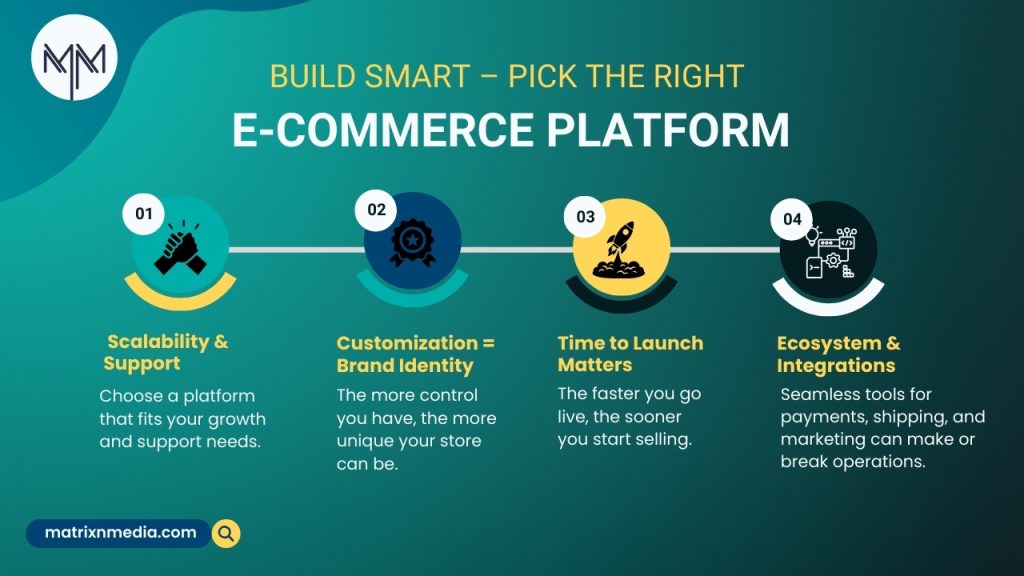
When choosing your e-commerce platform, consider:
- Your technical skills
- Your budget (both now and as you grow)
- Your customization needs
- Your future growth plans
When selecting an e-commerce platform, the right choice depends on your business needs. For those prioritizing simplicity and support, Shopify is an excellent starting point. If flexibility is a priority and you are already using WordPress, WooCommerce might be the ideal solution. For large-scale operations that demand power and complete control, Magento is the platform to consider.
Regardless of the platform chosen, it is essential that it supports secure transactions, fast performance, and a seamless user experience. For expert help with choosing or setting up an e-commerce platform, Matrix Media Solutions can assist in launching a secure, scalable, and conversion-ready online store tailored to specific business goals.