

The e-commerce industry is entering a new era in 2026, driven by advanced technologies, heightened customer expectations, and a growing demand for seamless, personalised online shopping experiences. Launching an e-commerce store today is no longer just about setting up a website; it requires a strong strategy, the right technology, and a clear understanding of consumer behaviour.
At Matrix Media Solutions, we help businesses build future-ready digital commerce systems, and through our experience, we have identified ten essential considerations every brand must evaluate before going live.
1. Selecting the Right Platform for Growth
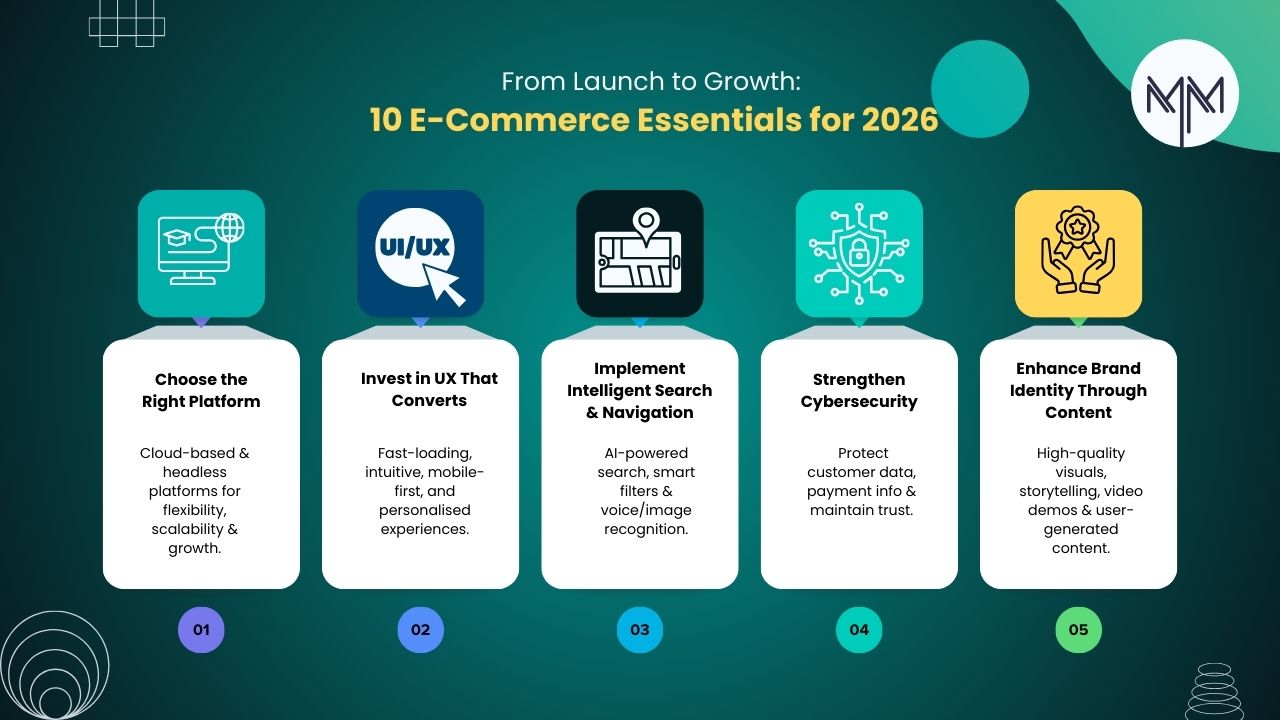
Selecting an e-commerce platform forms the foundation of your digital business. In 2026, companies increasingly prefer cloud-based and headless commerce platforms because they offer flexibility, speed and the ability to scale effortlessly. Before making a decision, it is important to consider how much traffic you expect, the level of customisation you require and whether you plan to expand internationally. A platform must support your business not just today but over the next five years. You have to choose a platform that aligns perfectly with their growth plans.
2. Investing in a User Experience That Converts
Today’s customers expect intuitive, frictionless journeys from product discovery to checkout. A cluttered, confusing interface can cost you sales immediately.
Key UX elements to focus on include:
- Quick page load (under 2 seconds)
- Clear navigation and product categorisation
- Mobile-first layouts
- High-quality visuals and videos
- Guest checkout options
In 2026, users also expect hyper-personalised layouts and AI-driven recommendations, the kind Matrix Media integrates seamlessly through tailored UX design.
3. Building Intelligent Search and Navigation
Product discovery has become one of the most critical factors in e-commerce success. Modern customers want instant results and accurate suggestions. Intelligent search powered by AI, image recognition and voice capabilities is becoming a standard rather than an advanced feature. A well-organised navigation structure and smart filtering options help customers find what they need without frustration. For e-commerce brands with large catalogues, this becomes even more essential. We are here to integrate intelligent search systems that reduce drop-offs and guide shoppers toward relevant products quickly.
4. Strengthening Cybersecurity from Day One
Security remains one of the biggest concerns in online commerce. As cyber threats grow more sophisticated, brands must protect customer data, payment information and website infrastructure with advanced security protocols. Encryption, secure payment gateways, compliance with global security standards and regular security audits contribute to building a trusted shopping environment. Customers today are more aware of online risks and will not hesitate to leave a store that appears unsafe.
5. Optimise for Mobile-First and App-Connected Shopping
More than 70% of online sales now come from mobile. In 2026, customers expect mobile experiences to be faster than desktop.
You should plan for:
- Responsive mobile layouts
- Progressive Web Apps (PWAs)
- Mobile-optimised payment flows (UPI, Apple Pay, Google Pay)
- Mobile-friendly checkout
- Push notifications for app users
Matrix Media specialises in developing PWAs and hybrid mobile apps that create app-like experiences without requiring a full mobile app build.
6. Build Trust with Strong Payment, Shipping & Returns Systems
The post-purchase journey is just as important as the browsing and checkout experience. Customers evaluate online stores based on the ease of payments, the reliability of deliveries and the fairness of return policies. Offering multiple payment options, transparent delivery timelines and a customer-friendly return process builds trust and encourages repeat purchases. Clear communication at every stage, from order confirmation to delivery tracking, plays a major role in customer satisfaction.
7. Strengthening Brand Identity Through Content
A strong brand identity sets you apart in a crowded e-commerce landscape. High-quality visuals, engaging product descriptions, storytelling-driven landing pages and authentic customer testimonials all contribute to building credibility. Customers trust brands that communicate clearly and consistently.
In 2026, video product showcases, interactive guides and user-generated content are becoming increasingly influential in purchasing decisions. Brands must develop content strategies that reflect their values and connect emotionally with customers.
8. Using Data and Automation to Drive Sales
Data-driven marketing and automation tools have transformed the way e-commerce businesses engage with customers. Automated email sequences, personalised recommendations, AI-driven ad targeting and real-time analytics give brands the ability to react quickly and intelligently to customer behaviour. Instead of relying solely on intuition, businesses can use concrete data to refine strategies and optimise performance.
9. Ensuring Peak Performance and Fast Loading Speed
A fast website is essential for maintaining user engagement. Even a one-second delay can reduce conversions significantly. Performance optimisation includes compressing images, improving server response times, minimising code weight and integrating powerful content delivery networks.
A smooth, fast-loading e-commerce store encourages users to explore more products and complete their purchase journey without interruption. Our development team at Matrix Media ensures that every website we build meets the highest performance standards.
10. Designing for Future Scalability and Integrations
Finally, an e-commerce store must be built with the future in mind. Whether you plan to expand your catalogue, launch in new regions or integrate with ERPs, CRMs, marketplaces or AI systems, your platform should be flexible enough to support these changes. Scalability is the key to long-term success. At Matrix Media, we create modular e-commerce architectures that evolve as your business evolves, ensuring that growth never becomes a technical obstacle.

Conclusion
Launching an e-commerce store in 2026 requires more than just technical setup. It demands a vision, a strong digital foundation and a deep understanding of modern customer expectations. By focusing on platform selection, user experience, mobile optimisation, security, and future scalability, businesses can build online stores that not only attract customers but also retain them.
Matrix Media Solutions brings years of experience in e-commerce development, digital marketing, UI/UX design, cloud solutions, and mobile app development. We help businesses build powerful, scalable, and conversion-driven e-commerce platforms tailored to their long-term goals.
If you’re planning to launch or upgrade your online store in 2026, our team can help you create a solution that stands out and grows with your business!