

AI 2.0: Redefining Automation or Creating Ethical Dilemmas?
The dawn of Artificial Intelligence (AI) has been one of the most technological advancements of the 21st century. From automating mundane tasks to revolutionizing industries, AI has become integral to our daily lives.
But as we step into the era of AI 2.0, a more advanced, autonomous, and self-learning iteration of AI, we are faced with a critical question: Is AI 2.0 redefining automation, or is it creating ethical dilemmas that could reshape humanity’s future?
We at Matrix Media Solutions are committed to investigating the nexus of innovation, ethics, and technology. In this blog, we explore the potential benefits and risks of AI 2.0, looking at how it is changing several industries and posing important moral dilemmas that require our consideration.
AI 2.0: The Next Frontier of Automation
AI 2.0 represents a significant leap from its predecessor. Unlike traditional AI, which relies on predefined rules and structured data, AI 2.0 is powered by deep learning, neural networks, and generative models. It can process unstructured data, learn from patterns, and make decisions with minimal human intervention. Automation is being redefined in ways that were previously unthinkable by this development:
-
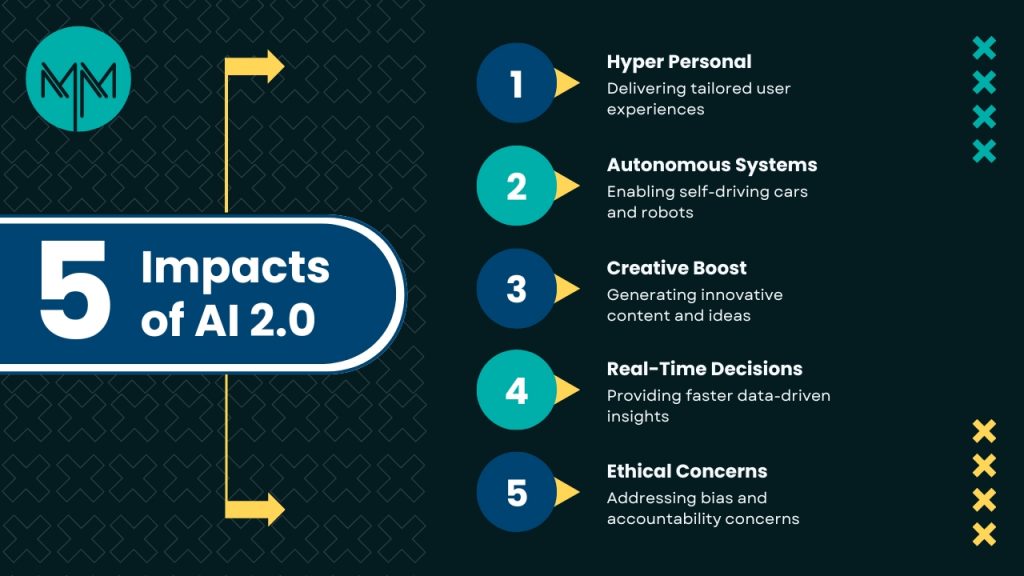
Hyper-Personalization in Marketing
AI 2.0 enables businesses to analyze consumer behavior at a granular level, delivering hyper-personalized experiences. At Matrix Media Solutions, we leverage AI-driven insights to create targeted campaigns that resonate with audiences on a deeper level. From dynamic content creation to predictive analytics, AI 2.0 is transforming how brands connect with their customers.
-
Autonomous Systems
Industries like healthcare, manufacturing, and transportation are witnessing the rise of autonomous systems powered by AI 2.0. Self-driving cars, robotic surgeries, and smart factories have gone beyond science fiction; they are realities that enhance efficiency and reduce human error.
-
Creative Collaboration
AI 2.0 involves working with people on creative projects rather than only automating duties. Innovative content is being produced by writers, designers, and artists with the help of tools like generative AI. Our creative operations are enhanced by AI, which helps us provide our clients with state-of-the-art solutions.
-
Real-Time Decision Making
With its ability to process vast amounts of data in real time, AI 2.0 is empowering businesses to make faster, data-driven decisions. Whether it’s optimizing supply chains or predicting market trends, AI 2.0 is a game-changer for decision-making processes.
The Ethical Dilemmas of AI 2.0
While the potential of AI 2.0 is undeniable, its rapid advancement has sparked a wave of ethical concerns. As AI systems become more autonomous, the line between human control and machine decision-making is blurring. Here are some of the key ethical dilemmas posed by AI 2.0:
-
Bias and Discrimination
The quality of AI systems depends on the quality of the data they are trained on. If the training data contains biases, the AI will perpetuate and even amplify them. This raises concerns about fairness and discrimination, particularly in areas like hiring, lending, and law enforcement. We are dedicated to making sure that a variety of objective datasets serve as the foundation for our AI-driven solutions.
-
Job Displacement
As AI 2.0 automates more tasks, there is a growing fear of job displacement across industries. While AI creates new opportunities, it also renders certain roles obsolete. The challenge lies in reskilling the workforce and ensuring a just transition to an AI-driven economy.
-
Privacy Concerns
AI 2.0 thrives on data, often requiring access to personal information to function effectively. This raises significant privacy concerns, especially in the age of data breaches and surveillance. Striking a balance between innovation and privacy is a pressing ethical challenge.
-
Accountability and Transparency
As AI systems make more decisions autonomously, it becomes difficult to determine accountability. Who is responsible when an AI system makes a mistake? Ensuring transparency in AI algorithms and decision-making processes is crucial to building trust and accountability.
-
Existential Risks
Some experts warn that highly advanced AI systems could pose existential risks to humanity. While this may sound like a plot from a sci-fi movie, the possibility of AI systems acting in ways that are misaligned with human values cannot be ignored.

Balancing Innovation with Responsibility
We believe that there is hope for overcoming the ethical dilemmas presented by AI 2.0. By taking a proactive and accountable stance, we can maximize AI’s potential while reducing its hazards. We are taking the following actions to manage the ethical areas:
Ethical AI Frameworks: We are committed to developing and adhering to ethical AI frameworks that prioritize fairness, transparency, and accountability. Our AI systems are designed to align with human values and societal norms.
Bias Mitigation: We invest in diverse datasets and rigorous testing to identify and mitigate biases in our AI models. By ensuring that our AI systems are fair and inclusive, we aim to create solutions that benefit everyone.
Privacy by Design: Privacy is at the core of our AI solutions. We implement significant data protection measures and ensure that our AI systems comply with global privacy regulations.
Collaboration and Advocacy: We believe that addressing the ethical challenges of AI requires collaboration across industries, governments, and civil society. We actively participate in discussions and initiatives aimed at shaping responsible AI policies.
Encouraging the Employees: We are committed to equipping our employees with the knowledge and abilities they need to prosper in an AI-driven environment. We guarantee that our staff stays at the forefront of innovation by implementing training and upskilling initiatives.
The Future of AI and Automation
AI 2.0 is a societal breakthrough as much as a technical advancement. The decisions we make now will determine how AI develops in the future and how it affects people since we are at the nexus of ethics and innovation.
Matrix Media Solutions remains committed to guiding businesses through this transformative era, ensuring that technology serves humanity, not the other way around. However, we also understand how critical it is to confront its moral conundrums. We can build a future where technology is a force for good by adopting a responsible and human-centered approach to AI.
Conclusion
The emergence of AI 2.0 raises significant ethical issues in addition to amazing benefits. Companies need to be acutely conscious of the responsibilities that accompany technical power as they traverse this changing environment.
At Matrix Media Solutions, we’re committed to assisting our clients in carefully embracing AI 2.0, optimizing its advantages while maintaining the greatest moral standards. Want to gain more insights on AI 2.0? Our experts are ready to help you. Contact us!