


Google Ads can be a powerful tool for driving traffic to your website; however, the real challenge lies in converting that traffic into paying customers. The success of your Google Ads campaign depends not only on selecting the right keywords or writing compelling ad copy but also on optimizing your landing pages to maximize conversions.
Conversion Rate Optimization (CRO) focuses on improving the user experience and making sure that visitors complete your desired actions, whether it’s filling out a form, making a purchase, or signing up for a service.
We are going to explore the best practices for optimizing your landing pages to ensure your Google Ads campaign yields the highest possible return on investment (ROI). Matrix Media Solutions considers that web development and digital marketing should be approached holistically, integrating data analytics, design, and user experience.
Now let’s explore the crucial CRO phases—>
1. Ensure an Effective User Experience
One important component of conversion rate optimization is user experience (UX). It is doubtful that visitors will stay long enough to convert if they arrive at a website with poor usability or unclear layout. From the time the user clicks on your advertisement until they do the intended action, this experience needs to be error-free for Google Ads.
Best Practices:
- Fast Loading Time: A slow-loading page can lead to high bounce rates, especially when users are coming directly from a Google Ad. Therefore, we use tools like Google PageSpeed Insights to test and improve your page speed.
- Mobile Optimization: A large number of Google Ads users come from mobile devices. We ensure that your landing page is fully optimized for mobile devices, including responsive design, easy-to-click buttons, and fast load times.
- Clear Layout: Keep the layout simple and intuitive. Overcomplicating the options available to users may distract them from the primary goal of the page.
2. Align Landing Page Content with Ad Copy
The user’s journey begins the moment they click on your ad! If the content of your landing page doesn’t match what the user was expecting based on the ad, they’ll likely leave your site without converting. This alignment is crucial for maintaining the relevance and trust of your audience.
Best Practices:
- Consistent Messaging: Matrix Media Solutions helps you to ensure the message in your ad copy directly mirrors the content on your landing page. If your ad promises a 20% discount, the landing page should highlight the offer clearly and early.
- Headline Matching: Your landing page’s headline should mirror or build upon the key promise in your ad. This consistency reassures the user that they’ve arrived in the right place.
- Targeted Content: If you are running multiple ads targeting different user segments, you have to make sure your landing pages are made for each segment. For example, a landing page for business owners should highlight B2B solutions, while a consumer-focused page should emphasize ease of use or affordability.
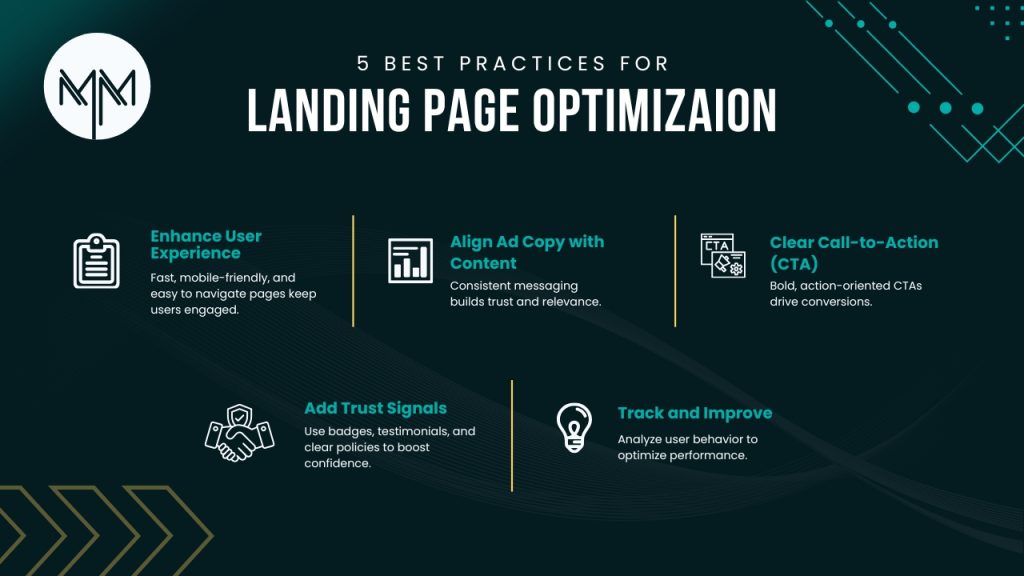
3. Create Clear and Compelling Call-to-Action (CTA)
A strong, well-designed call-to-action (CTA) is arguably one of the most important elements of a landing page. The CTA should guide users toward the action you want them to take, whether it’s signing up for a newsletter, downloading a resource, or making a purchase.
Best Practices:
- Use Action-Oriented Language: Your CTA should use compelling language that tells users exactly what to do. Words like “Get,” “Download,” or “Claim Your Offer” are more effective than a generic “Submit” or “Click Here.”
- Make the CTA Stand Out: Your CTA button should be easy to find and stand out visually on the page. Therefore, we recommend using contrasting colors to draw attention but ensure they fit with the overall design.
- Positioning and Repetition: We help you to position your CTA above the fold for users who don’t want to scroll, and repeat the CTA near the bottom of the page for users who read through the content.
4. Optimize for Trust and Credibility
When it comes to conversions, trust is essential. If customers believe that the company is trustworthy and that their information is safe, they are more likely to convert. It’s crucial to incorporate trust signals and make sure your landing page is secure.
Best Practices:
- Social Proof: We generally recommend businesses include customer testimonials, reviews, or case studies that show how your product or service has helped others. Social proof is a powerful way to reassure visitors and nudge them toward converting.
- Trust Badges: Display trust seals or badges, especially if you’re asking for sensitive information like credit card details. This includes SSL certificates, payment security badges (e.g., Visa, MasterCard), and any other industry-specific certifications.
- Return/Refund Policies: If relevant, highlight your return or refund policies to reassure visitors that they have nothing to lose by making a purchase.
5. Use Relevant and High-Quality Visuals
Your landing page’s visual design is very important for user engagement and trust. Make use of top-notch pictures and videos that support your message and are pertinent to your offering.
Best Practices:
- Hero Image: The hero image or video at the top of the page should represent your brand and show your product in action or how it benefits the user.
- Images of People: Including images of real people, particularly those who resemble your target audience, can make your landing page feel more relatable and trustworthy.
- Minimalism: Avoid overwhelming users with too many images or distracting elements. A clean, focused design with a clear path toward conversion is key.
6. Track and Analyze Data
Monitoring your landing page’s performance is essential to figuring out where it needs to be improved. To find problems and areas for improvement, employ analytics tools to monitor user behavior, conversion rates, and bounce rates.
Best Practices:
- Google Analytics: Monitor metrics like bounce rate, average session duration, and conversion rate to understand how users interact with your landing page.
- Heatmaps: There are several tools that can provide heatmaps that show where users are clicking and how far they’re scrolling. This can provide valuable insights into how users are experiencing your page.
- Conversion Funnel Analysis: Analyze the entire conversion process from the first click on your ad to the final action to identify where users drop off. This will help you identify areas of friction to address.

Achieving high conversion rates and optimizing the efficacy of your ad expenditure require optimizing landing pages for Google Ads. You can greatly increase the performance of your landing pages by concentrating on the user experience, matching your messaging to your advertisements, streamlining forms, utilizing trust signals, and testing your pages frequently.
Conclusion
At Matrix Media Solutions, we specialize in combining UX design, development, and data-driven marketing strategies to help businesses optimize their digital presence and achieve measurable results.
We understand your business requirements, and as a result, we help you to incorporate these best practices for Conversion Rate Optimization, with which you can turn your Google Ads traffic into loyal customers and drive more value from your campaigns.
If you’re looking for expert help in landing page optimization or Google Ads management, reach out to Matrix Media Solutions today to discuss how we can help you improve your conversion rates and grow your business!